Studio Journal
Can You Tuft That Painting? Usually the Answer Is the Painting's
The Sunflowers rug is $225 and real. Which paintings hold up when they are rebuilt in yarn, which fall apart, and the copyright line a commission cannot cross.
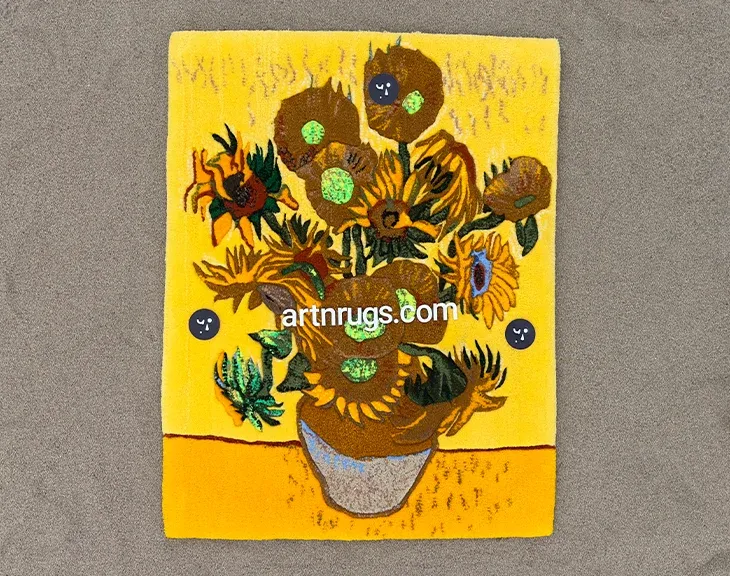
One painting in this studio’s catalog is a replica: Van Gogh’s Sunflowers, tufted by hand in acrylic yarn, 31.5 by 23.6 in, $225, hanging loops already on the back. It gets more questions than orders, and almost always the same one. Could you do this other painting?
The answer is rarely about the studio. It is about whether the painting can survive being rebuilt in a material that works nothing like paint.
Three constraints, and they are not negotiable
Yarn is opaque. Oil paint is not. Van Gogh dragged wet yellow through wet yellow and your eye reads both at once; glazing stacks transparent films so the color underneath still shows. Pile cannot do either. Every strand is solid and sits at a fixed height, so a continuous gradient becomes a decision: this shade or the next one.
The palette is finite. A painter mixes whatever the picture needs. A tufting studio pulls from the shades actually on the shelf, roughly forty of them. A face carried by twenty half-tones arrives with six.
Viewing distance is a room, not a museum rail. Detail smaller than a fingertip will not be there. The composition has to hold from across a living room or it does not hold at all.
Why Sunflowers works anyway
Because Van Gogh had already done half the translating. He painted in committed blocks of color with visible, directional strokes, which is close to how a tufting gun lays pile in the first place. Nothing had to be flattened; the picture was built that way.
And the pile gives something back that a poster never will. Laid to run the way the brush ran, it catches light differently as you walk past. Sheared in stages, a petal stands a couple of millimeters above the ground behind it, which reads as depth rather than as texture.
The paintings that hold, and the ones that collapse
Hold up: post-Impressionists, the Fauves, Klimt’s patterned grounds, Japanese woodblock prints. Anything that thinks in shapes.
Collapse: portraits carried by subtle modeling, anything built on glazing, crowded scenes where the whole interest is small incident. A Vermeer interior is a superb painting and a bad rug, and no amount of care changes that.
The copyright line, stated plainly
A replica can be commissioned only from a painting whose copyright has run out.
Van Gogh died in 1890, Klimt in 1918, Hokusai in 1849. All long clear. Most of the twentieth century is not: copyright runs for the artist’s life plus seventy years, so Picasso, Matisse, O’Keeffe and Warhol are requests this studio turns down, however well the pictures would suit yarn.
Original work in the spirit of a movement is a different thing and is fine. The Cubist lobster reproduces no canvas; it is a new picture speaking an old language. Bring an idea instead of a specific painting and the problem goes away entirely.
What ordering one looks like
Send the painting and the size your wall wants. A hand-drawn color mockup comes back showing which shades the palette can actually reach and where the picture has to simplify. Nothing gets tufted until you have seen it and said yes.
After that it is the standard run: three business days at the smallest size, up to seventeen at the largest, then five to ten days on the road. Shipping anywhere in the US is free and tracked. Pricing follows the same size ladder as any other commission from $210, because a replica costs the same hours as an original design of the same dimensions.
If it is the Sunflowers piece you want, it sits in the wall hangings, one in stock. If it is a different painting, out of copyright and built from shapes rather than glazes, start on the commission page.
Commission
Have a piece in mind?
Made to order in any size. We reply within 24 hours with a price and a lead time.
Send an inquiry