Studio Journal
How a Hand-Tufted Rug Is Made: From Sketch to Final Shearing
Watch a hand-tufted piece take shape: pencil drawing, real yarn samples, the gun, the glued back, staged shearing. Made to order from three business days.
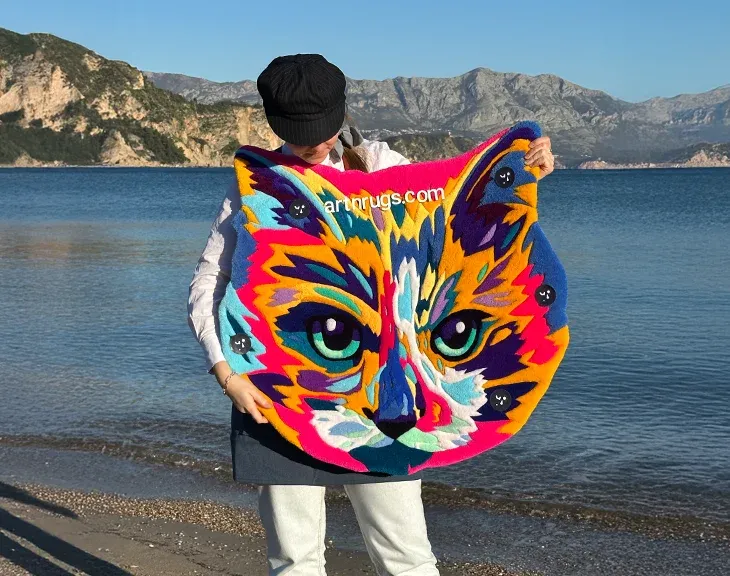
Nothing ships out of here that did not start as a pencil drawing and finish under a pair of shears. What sits between those two points: a motorized gun, cones of acrylic yarn, and a sheet of backing cloth pulled drum-tight across a frame. The stages are laid out below, with short clips shot right at the frame while the work was happening. The sequence does not change if the piece is an abstract off our own catalog, a likeness of somebody’s cat, or a composition headed for the wall over a couch. None of it gets printed. What you end up with is a picture assembled out of yarn, one field of color after another.
Everything begins on paper
No yarn gets measured out until there is something worth the trouble. Open a commission with whatever is already on your phone: a paragraph explaining the idea, snapshots for reference, a scribble you made at the kitchen table. That is enough to work from. Ksenia Derr, who trained for nine years at the Stieglitz Academy of Art and Design (Saint Petersburg), puts the motif down in pencil before any other step. On an animal portrait that means the coat and the wet catch of light in an eye, worked out by hand on paper.
The pencil work then moves into Photoshop and turns into a vector mockup that pins down every shade and every edge of the piece you are going to receive. It is still drawn by a person; there is no AI filter anywhere in the chain. The software is there to lock color and proportion, so that both sides of the conversation are picturing the identical object before anybody threads a gun.
Real yarn samples, before anyone commits
You get the palette before the gun is switched on. We put the actual shades in front of you, physical samples instead of a screen approximation, along with a mockup built from those exact shades and a read on how the combination behaves under a window at noon versus a lamp at night. Once the dimensions, the shades and the treatment are settled, the final mockup goes out with a price. A deposit holds the slot on the frame, and work starts.
Getting the drawing onto cloth
The approved artwork gets transferred to backing cloth stretched across a frame, which is to tufting roughly what a primed canvas is to oil painting. Outlines go down with a marker, and so do the small things: the ring around an iris, the notch in an ear. Every later stage leans on this one, because the gun can only follow a line somebody already put there.
Steering the gun through the color
Now the tufting itself. A handheld gun drives yarn through the stretched cloth in fast repeated strokes, filling one color field at a time and staying inside the traced outline. Pile height is a decision rather than an accident, and it gets made while the work moves along. The hardware for wherever the piece is headed, hanging loops or a floor backing or a framing allowance, is settled at this same stage.
The reverse does as much work as the face. A strong backing traps the yarn so it cannot pull free, and a piece meant for a wall gets loops attached to that back. Most of our clients hang these: over the couch, in a den, on the wall of a nursery. They are built first of all as textile wall art, and the construction is planned around that from day one. When a piece is going to sit on the floor instead, a non-slip base goes on the back, though regular or heavy foot traffic is not recommended.
Glue, dry time and shearing in passes
Once the fields are full, adhesive goes onto the back and locks every stitch in place. It dries all the way through before the piece leaves the frame, and there is no shortcut around the waiting. Shearing then happens in passes: the whole surface gets leveled and the surplus yarn comes off, then a trimmer shapes each detail, then scissors finish the surface by hand. Flat blocks of color turn into carved outlines and genuine relief right here, and no other step does it. After the last pass you get photographs and video to sign off on, the balance is settled, and the piece goes into packing.
Yarn, weight and sizing
We tuft in acrylic, acrylic-wool blends and pure wool, chosen for how they wear, how they feel and how well they hold a color. What comes off the frame is denser than most people expect: a 33 × 33 in portrait runs about 5.25 lbs, substantial enough to lie flat and still light enough that ordinary picture hooks in drywall will carry it. Since the artwork is drawn fresh for every order, there is no fixed size list, and the quote follows the square footage.
Lead times, shipping and what happens after
Made to order, a piece is ready to leave in three to seventeen business days, depending on its size. Anything already finished on the shelf goes out inside a few business days. Everything is packed carefully and travels with free tracked shipping across the US, and a 7-day guarantee covers whatever goes sideways in transit. Figure five to ten days on the road once it is dispatched.
Upkeep afterward comes close to nothing: a lint roller for surface dust and pet hair, a light pass with the vacuum now and then, a professional cleaner for anything that really soaks in. That is the entire list, and it is what holds the color at full strength.
To see what the sequence actually produces, look through the rugs and textile wall pieces in the catalog, or the wall-hanging pieces intended primarily as textile wall art. If something of your own is already forming, whether it starts from a photo of your dog or cat or from a sketch, the custom order page covers the first move: send the idea over, and a quote plus a lead time comes back inside 24 hours.
Commission
Have a piece in mind?
Made to order in any size. We reply within 24 hours with a price and a lead time.
Send an inquiry