Studio Journal
Tufting vs Punch Needle: What’s the Difference?
One is a hollow needle worked by hand, the other is a motor in your fist. How the tools, the pace and the finished pile differ, from a working studio.
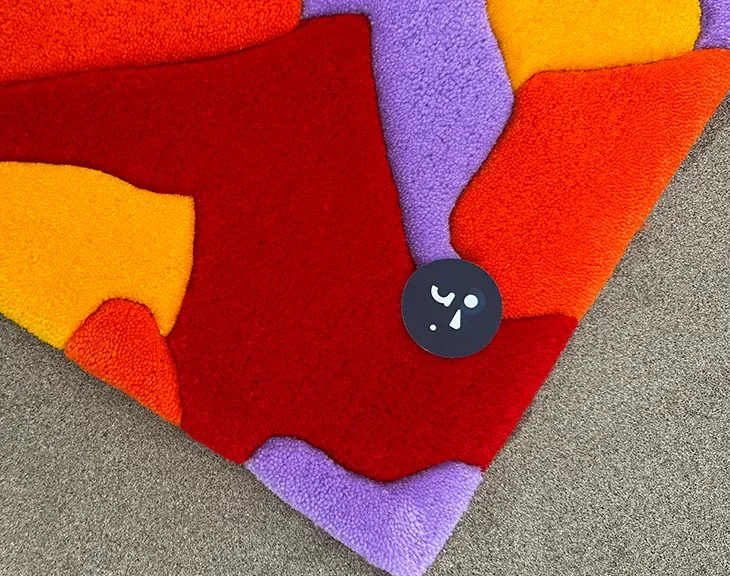
People mix these two up constantly, and it is easy to see why. Each one builds an image by forcing yarn through cloth held under tension, they occupy the same shelf of the textile world, and in casual conversation anything made either way gets called a tufted rug. They are still two different tools running at two different speeds, and they leave two different surfaces behind. What is worth comparing is the hardware, the tempo and the finish. Neither craft has to lose for the other to be good.
Where the two overlap
The opening moves are identical. Cloth goes onto a frame and gets pulled tight as a drumhead, a design is marked onto it, and yarn is pushed through the weave along those marks. In both crafts the fabric itself grips the yarn, and in both crafts the maker fills the picture one region and one shade at a time. Somebody watching from across a room would have a hard time telling which was which.
Punch needle: no motor anywhere
The name is entirely literal. It is a hollow needle carrying yarn, and the maker shoves it through the cloth by hand, one stab at a time. Every stab leaves a loop standing on the opposite face, and loop after loop, row after row, the surface accumulates. Nothing is powered. The work is quiet, it travels well, and it is slow in the good sense, closer in feel to embroidery than to machinery. That suits smaller formats, wall hangings and finely worked loop-pile texture. What holds those loops in place is usually nothing more than the weave of the cloth.
The tufting gun: a motor in your fist
The gun is the powered relative. It works the needle for you, many times per second, which turns the maker’s job into steering: guiding the tool along the marked lines while it packs yarn into the cloth far quicker than any hand could. Depending on the machine you get cut pile, each stitch clipped into standing ends, or loop pile. That speed is what makes big formats and heavy density realistic, but the gun charges for it: you need a rigid frame, a backing cloth tough enough to absorb the pounding, and a real finishing stage afterward, because tufted yarn has to be locked down with a glued second backing.
What the finished surface tells you
You can read the tool off the piece. Punch-needle work shows its loops, a ribbed, stitch-by-stitch texture that keeps the charm of visible handwork. Cut pile from a gun reads as a dense, velvety field, and it takes shearing: cut level so the drawing stays sharp, then carved around individual features so the surface picks up genuine depth. That sculptural pass, with hard edges between shades and relief worked around an animal’s eye, belongs to cut pile and to the gun. The reverse sides differ too. A tufted piece carries a glued back that traps the yarn and accepts either a non-slip layer or hanging loops; punch-needle work generally leans on the tension of the cloth alone.
Which one matters to you
If you want to make one yourself, the punch needle is the calmer and cheaper door in, the gun is faster but arrives with a bigger setup, and both of them pay back patience. If you are buying rather than building, the tool is close to irrelevant next to what got done with it. The drawing, the yarn, the shearing and the finishing are what decide whether a piece is worth hanging, no matter which needle put it there.
What we run here
Everything we make comes off a handheld gun: acrylic yarn pushed through a stretched textile base, one color field after another, then sheared in stages, leveled first and sculpted around the details second. We picked the gun for what it makes possible at this scale, dense cut pile, large formats, and portraits where the shearing is what gives an eye and a coat their depth. The full sequence, with clips shot at the frame, is in how a pet portrait rug is made from a photo; the output lives in the rug catalog and among the wall-hanging pieces intended primarily as textile wall art. If reading this has left you wanting a likeness of your own dog, cat or horse, that is a custom pet rug, and every other kind of commission opens on the custom order page.
Commission
Have a piece in mind?
Made to order in any size. We reply within 24 hours with a price and a lead time.
Send an inquiry