Journal
Tufting vs Punch Needle: What’s the Difference?
Both build a picture from yarn on stretched cloth: one by hand, one with a motor. How punch needles and tufting guns differ in pile, speed and finish.
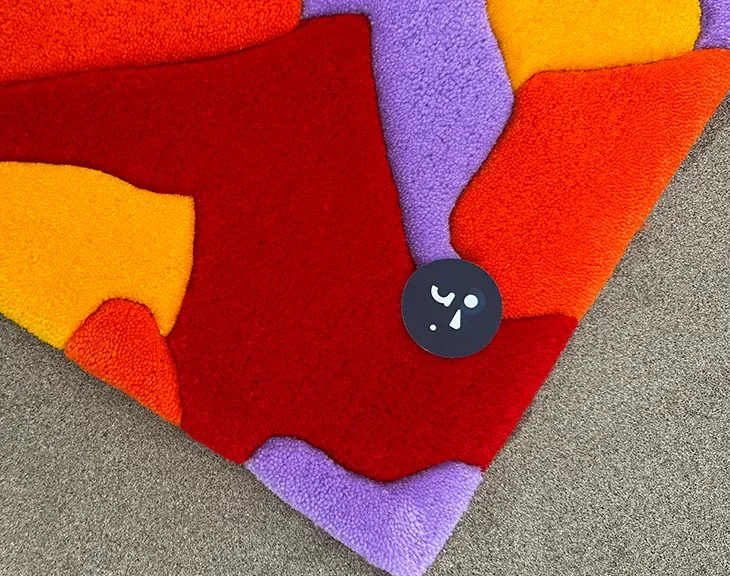
Tufting and punch needle get mistaken for each other constantly, and the confusion is understandable: both build a picture out of yarn pushed through stretched cloth, both live in the same corner of the textile world, and a finished piece made either way can be called a “tufted rug” in casual speech. But they are different tools with different rhythms, and they leave different surfaces behind. The useful comparison is in the tools, pace and finish; neither craft needs to win.
What the two crafts share
Both start the same way: a backing cloth is stretched drum-tight on a frame, a design is drawn onto it, and yarn is driven through the cloth along the drawn lines. In both cases the yarn is held by the fabric it passes through, and in both cases the maker works the design area by area, colour by colour. Someone watching from across the room could be forgiven for thinking they are the same craft.
The punch needle: a hand tool
A punch needle is exactly what the name says: a hollow needle, threaded with yarn, that the maker pushes through the cloth by hand, one punch at a time. Each punch leaves a loop of yarn on the far side of the fabric; row after row of loops builds up the surface. There is no motor. The craft is quiet, portable and slow in the pleasant sense of the word, closer in spirit to embroidery than to machinery, and well suited to smaller pieces, wall hangings and detailed loop-pile textures. The loops are typically held by the weave of the fabric itself.
The tufting gun: a machine in the hand
A tufting gun is the motorized member of the family. It drives the needle for you, many times a second, so the maker’s job becomes steering: guiding the gun along the drawn lines while it packs yarn into the cloth far faster than any hand tool could. Depending on the machine it produces cut pile, each stitch trimmed into upright ends, or loop pile. The speed makes large formats and dense surfaces practical, but the gun asks for more in return: a sturdy frame, a strong backing cloth that can take the hammering, and a proper finishing stage afterwards, because tufted yarn must be locked in place with a glued secondary backing.
The differences you can see in the finished piece
The surface tells you which tool made it. Punch-needle work reads as loops: a corduroy-like, stitch-by-stitch texture with the charm of visible handwork. Tufted cut pile reads as a dense, velvety field, and it can be sheared: trimmed level so the drawing stays crisp, then carved around details so the surface gains real depth. That sculptural shearing, with sharp edges between colour fields and relief around an animal’s eye, is a cut-pile, tufting-gun trait. The back differs too: a tufted rug carries a glued backing that locks the yarn and takes a non-slip layer or mounting loops; punch-needle pieces usually rely on the tension of the fabric itself.
Which one should you care about?
If you want to take up the craft yourself, punch needle is the calmer, simpler entry, tufting is the faster tool with the bigger setup, and both reward patience. If you are buying rather than making, the tool matters less than what is done with it: the quality of the drawing, the yarn, the shearing and the finishing decide whether a piece is worth living with, whichever needle it came from.
What we use in our studio
Our rugs are tufted with a hand-held tufting gun: acrylic yarn driven through a stretched textile base, colour field by colour field, then sheared in stages: level first, then sculpted around the details. We chose the gun for what it makes possible at our scale: dense cut pile, large formats, and portraits where shearing gives fur and eyes their depth. The whole process, with clips filmed at the frame, is in how a hand-tufted rug is made; the results are in the rug catalogue and the wall-hanging pieces intended primarily as textile wall art. And if the comparison has left you wanting a tufted piece of your own, the custom order page is where that starts.
Commission
Have a piece in mind?
Made to order in any size. We reply within 24 hours with a price and a lead time.
Send an enquiry