Journal
How a Hand-Tufted Rug Is Made: From Sketch to Final Shearing
See how a hand-tufted rug is made in our studio, from the first drawing and yarn palette to tufting, backing and multi-stage shearing.
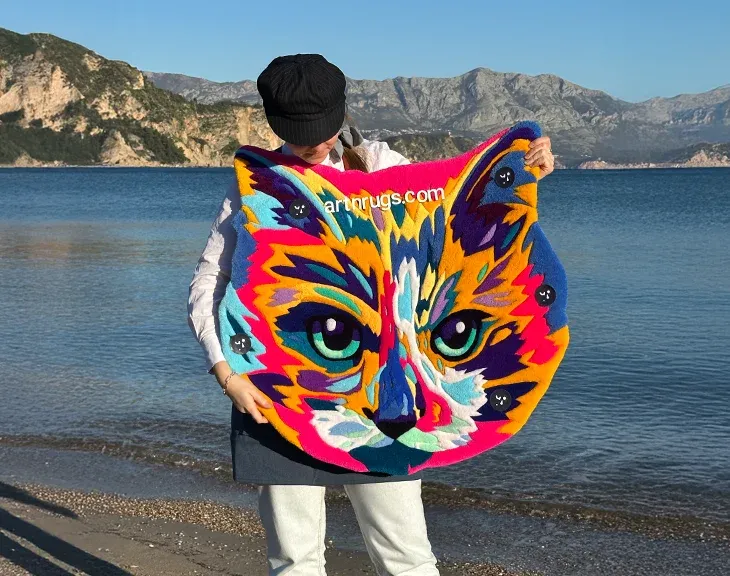
Every rug that leaves our studio begins as a drawing and ends under a pair of shears. In between are a tufting gun, acrylic yarn and a textile base stretched tight on a frame. The handwork is shown here step by step, with short clips filmed at the frame. The process is the same whether we are tufting a design from our own catalogue, a portrait of somebody’s cat, or a piece that will hang on a wall like a painting. A hand-tufted rug is never a print: it is a picture built from yarn, one pass of colour at a time.
It starts with a drawing
Nothing gets tufted until there is a picture worth tufting. A commission opens with whatever you can send: a detailed idea, reference photographs or a rough sketch. That is enough context to start refining the design. Ksenia Derr, who trained at the Stieglitz Academy of Art and Design in Saint Petersburg, draws the motif by hand first; for animal portraits, fur textures and eye details are rendered in pencil before anything else happens.
The drawing then moves into Photoshop, where it becomes an exact vector mockup that captures every colour and detail of the future rug. This is still hand-drawn work, not an AI filter. The software fixes colours and proportions, so that you and the studio are looking at the same future rug before a single strand of yarn is cut.
Colours you can check before work begins
Before tufting starts, you see the palette. We show the yarn shades up front: real samples rather than screen colours, and a mockup built from those shades, including how they read in daylight and in evening light. Once size, colours and style are agreed, we send the final mockup together with a quote; a deposit confirms the order, and the studio begins.
The design moves onto fabric
The approved drawing is transferred onto the textile base: cloth stretched on a frame, the tufting equivalent of a primed canvas. Contours and the fine details, like the rim of an eye, are traced directly onto the fabric with a marker. This transfer decides everything that follows: the tufting gun can only follow lines that are already there.
Tufting, colour field by colour field
Then the tufting itself. A hand-held tufting gun pushes yarn through the stretched base, packing it into the cloth colour field by colour field, exactly along the traced lines. Pile height is managed deliberately as the work goes, and the fittings for floor, wall or framing are checked at the same stage, so the finished rug behaves the way its future home demands.
The back of the rug matters as much as the front. A strong backing locks the yarn in place; a floor rug gets a non-slip base that keeps it put on wood, tile or laminate, and a wall piece gets mounting loops on the reverse. Many of our clients treat these rugs as textile wall art, and the construction is planned for that from the start.
Backing, drying and multi-stage shearing
After tufting, an adhesive backing locks the yarn in place. We leave it to dry fully before removing the rug from the frame. Shearing then happens in several stages: first we level the entire pile and remove excess yarn, then shape every detail with a trimmer and finish the surface by hand with scissors. This is what turns flat colour fields into crisp outlines and sculpted relief. When the shearing is complete, we send final photographs and video for approval; the remaining payment is then completed and the rug is prepared for shipping.
What hand-tufted rugs are made of
We tuft with acrylic yarn, acrylic-wool blends and wool, chosen for durability, softness and how well the colour holds. The result is a dense, surprisingly solid object: a portrait rug of 84 × 84 cm weighs about 2.4 kg, heavy enough to lie flat on the floor, light enough to hang on a wall. Because every design is drawn from scratch, any size can be commissioned; the price follows the area.
How long it takes and what happens after
A made-to-order rug ships in three to seventeen working days, depending on the size; pieces already in stock leave the studio within a few days. Every parcel is packed carefully and shipped free across the EU and to the US with a tracking number. A 7-day guarantee covers any transit issues. The usual delivery time is five to ten days.
Day-to-day care of the finished rug is short: a lint roller for light dirt, a gentle vacuum when needed, and professional cleaning for deep stains; that is what keeps the pile bright.
To see what this process produces, browse the rugs and textile wall pieces in the catalogue, or the wall-hanging pieces intended primarily as textile wall art. If a rug of your own is taking shape in your head, from a photo of your pet or from a sketch, the custom order page explains how to start: send the idea, and we reply with a quote and a lead time within 24 hours.
Commission
Have a piece in mind?
Made to order in any size. We reply within 24 hours with a price and a lead time.
Send an enquiry