Journal
What a Painting Loses, and Gains, in Yarn
Van Gogh's Sunflowers rebuilt in acrylic yarn. Which paintings survive being tufted, which collapse, and where copyright draws the line on a commission.
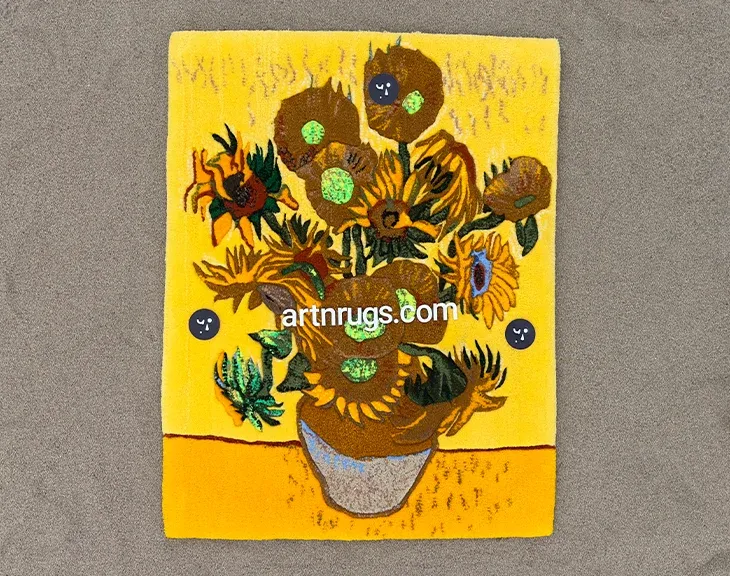
The studio has made exactly one replica of a famous painting: Van Gogh’s Sunflowers, rebuilt in acrylic yarn. It is the sort of commission people ask about more often than they order, usually with the same opening question. Can you just do this painting?
Sometimes. It depends less on the studio than on the painting, and the reason is worth explaining, because it decides whether the finished piece looks like the work you loved or like a blurred cousin of it.
Yarn is opaque, and oil is not
An oil painting is built in layers you can see through. Van Gogh laid down a yellow, then dragged another yellow across it while the first was still wet, and the eye reads both at once. Glazing does the same thing more deliberately: thin transparent films stacked until the colour underneath glows through.
Yarn cannot do that. Every strand is opaque and sits at a fixed height. Where the painter had a continuous gradient, tufting has a decision: this shade, or the next one. A face modelled in twenty half-tones becomes a face modelled in six.
That sounds like pure loss, and for some paintings it is. But it also explains why Sunflowers works. Van Gogh already painted in blocks of colour with visible, directional strokes. Translating that into pile is not a compromise; the medium was halfway there.
What the pile gives back
A tufted replica has one thing the print on a museum shop poster never will: physical direction. The pile can be laid so it runs the way the brush ran, and the surface catches light differently as you cross the room. Shear it in stages and a petal sits proud of the ground behind it by a couple of millimetres. From a metre away that reads as depth, not as texture.
So the honest description is not that a rug reproduces a painting. It rebuilds the picture in a material that behaves differently, and names its source while doing it.
Which paintings survive the translation
Three qualities decide it.
Flat, committed colour. Post-Impressionists, the Fauves, Klimt’s patterned grounds, Japanese woodblock prints. Anything already thinking in shapes rather than in gradients.
Readable at arm’s length. A rug is looked at from across a room, not through a magnifier. If the picture depends on detail smaller than a fingertip, that detail will not survive being drawn in yarn.
Strong silhouette. The composition has to hold when the palette drops from thousands of mixed tones to the forty or so shades a tufting studio actually has on the shelf.
What fails: portraits carried by subtle modelling, anything built on glazing, crowded scenes where the interest lives in small incident. A Vermeer interior is a beautiful painting and a poor rug.
Copyright decides more commissions than taste does
This is the part that surprises people, so it comes with no hedging. A tufted replica may be commissioned only from a painting whose copyright has expired.
Van Gogh died in 1890 and Klimt in 1918, so their work is long out of copyright across the EU and the US. Most of the twentieth century is not: in the EU copyright runs for the author’s life plus seventy years, and a request for a Picasso, a Matisse or a Warhol is a request the studio has to decline, however much the picture would suit the medium.
Original work in the manner of a movement is a different matter, and it is allowed. The studio’s Cubist lobster is not a reproduction of anything; it is a new picture that borrows a language. Bring an idea rather than a specific canvas and the boundary disappears.
How a commission runs
Send the painting you have in mind and the size the wall wants. What comes back is a colour mockup drawn by hand, showing which shades the palette can actually reach and where the picture will have to simplify. Nothing is tufted until you have looked at that and agreed it still reads as the painting you asked for.
From there it is the ordinary process: a hand-tufted piece takes from three working days depending on size, with hanging loops fitted before it ships. Prices follow the same size ladder as every other commission, starting at €180, because a replica takes the same hours as an original design of the same dimensions.
If the Sunflowers piece itself is what you wanted, it is in the wall hangings and ready to go. If it is another painting, out of copyright and built from shapes rather than glazes, the commission page is where to start.
Commission
Have a piece in mind?
Made to order in any size. We reply within 24 hours with a price and a lead time.
Send an enquiry