Studio Journal
Printed or Hand-Tufted? Reading a Pet Rug Listing
Why a $19.95 dog rug and a $360 one are different objects: 12 mm of printed nap against 21 mm of acrylic pile, the backing, the size tolerance, and the listing words that give a print away.
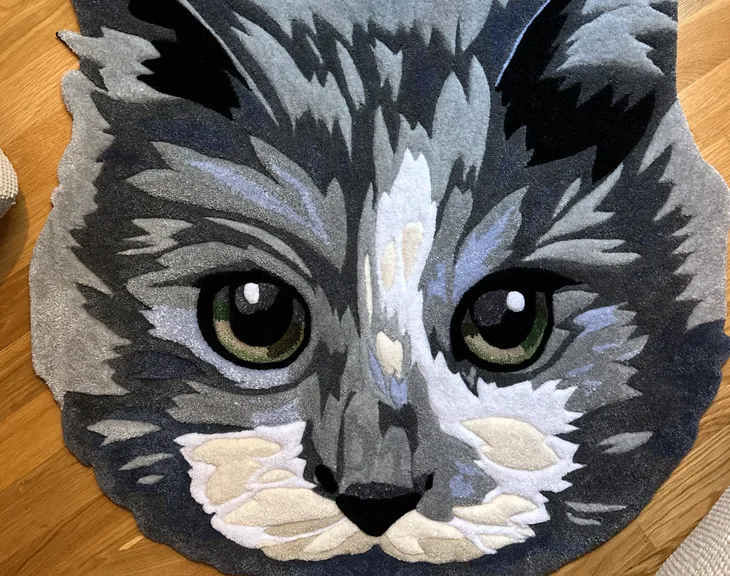
Put your dog’s breed and the word rug into a search box and the first screen of results runs from $19.95 to somewhere past three hundred dollars. The natural reading is good, better, best. That reading is wrong. The bottom of the range is a printed textile and the top is a tufted one, and the two share almost nothing beyond the word rug. Telling which is which takes about a minute, and most of that minute happens before anything ships.
Two objects, not two price tiers
A printed pet rug begins as a roll of knitted or bonded cloth. Your photograph is driven onto the face of it under heat, the outline is cut, the edge is finished, and a rubber sheet is laminated to the underside. A hand-tufted rug begins as bare canvas stretched tight on a frame. A gun pushes loops of yarn through that canvas, one field of color after another, until the drawing exists as fiber; the pile is then sheared level by hand and the back is closed with adhesive and a second cloth.
Neither sentence is an accusation. They describe two ways of making an object, and what follows is measurement rather than adjectives.
The listing is already telling you
Nothing here is a trade secret. Sellers of printed mats publish the build openly, because to them it reads as a spec sheet rather than a confession. Scan the description for:
- one-side printing, or sublimation and sublimated anywhere near the fabric
- non-woven fabric, crystal velvet, faux cashmere, flannel
- neoprene backing, rubber backing, a foam base
- overlock stitching around the perimeter in place of sewn binding
- shipping within 72 hours of design approval
- sizes offered as 16 × 24 in and 20 × 31 in, which are 40 × 60 cm and 50 × 80 cm rounded into inches for a US storefront
- the words doormat, kitchen rug or floor mat sitting inside the description of a portrait
- a stated tolerance of 1 to 2 inches on the finished size
Any one of them can turn up innocently. Three in the same paragraph is a build sheet.
Price the personalization
Open the seller’s whole catalog, not the single page a search dropped you on.
If a shop lists hundreds of finished designs and your custom portrait is priced at or below a stock print of a cardinal on a branch, then personalization is adding no cost because it is adding no work. Same roll, same press, different file. That one comparison is worth more than a page of description.
The side nobody photographs
A listing will shoot the face of a rug twelve ways and the back not at all. The absence is itself a data point.
Turn a printed mat over and you find an unbroken sheet: neoprene, PVC or a foam laminate, sold as the non-slip feature. None of the image is present back there, because the image never traveled deeper than the surface of the cloth.
Turn a tufted rug over and you find a second textile layer bonded across dried adhesive, with binding sewn all the way around. Hold it toward a window and the rows of stitching are legible through that layer, because the yarn really did pass through the canvas and come back out.
12 mm of nap against 21 mm of pile
A typical printed pet rug is built as roughly 8 mm of surface nap over a 4 mm cushion, so 12 mm all in. That nap is a raised finish brushed up on a knit, which is what faux cashmere and crystal velvet actually describe. Heights stay in millimeters here because that is how the mills quote them.
Tufted pile is cut yarn standing upright in the canvas, commonly reaching 21 mm, and what decides the result is not the height but how tightly the stitches sit under it. Ours runs about 290 grams of acrylic yarn per square foot against a trade norm of 227 at the same pile height. Tighter stitching is what lets a small shape hold together, which is the whole distance between an eye and a dark smudge.
Density settles the weight question too. A tufted piece at 33 × 24 in carries around 3.5 lbs of yarn before backing and binding go on. A printed mat covering the same area weighs a fraction of that, and the box tells you which one you bought before you have it open.
Where the color actually sits
Dye-sublimation pushes pigment into the top fractions of a millimeter of the fiber, and it is genuinely excellent at reproducing a photograph. What it cannot do is outlast abrasion: as the surface wears, the picture wears off with it. That is why the same sellers steer these pieces toward doormats and kitchen rugs, where a couple of seasons is the expected life.
In tufting there is no printed layer to lose. The color is the yarn, the full 21 mm of it, so scuffing the surface exposes the same shade underneath. That is why we make ours first of all as textile wall art. Put one on the floor and it works as a decorative rug, though regular or heavy foot traffic is not recommended.
A black dog is not black
Here is the difference that decides whether you recognize the animal, and no measurement captures it.
A press prints what the file says. Where the photograph goes dark, the ink goes dark. Somebody copying that photograph in yarn without thinking does the same thing, reaching for black wherever the coat is black, and the result is a silhouette with two eyes stuck into it.
A black coat contains almost no black. It turns gray where light lands on it, blue in the shadow under the jaw, warm brown wherever the undercoat shows through. Painters have built volume out of exactly that for centuries. It is why a black dog in a tufted portrait reads as a dog instead of a hole, and it is also why the step resists automation: choosing which gray goes where is a judgment call, not a filter.
The size you were promised
Printed rugs are cut from stock and overlocked, and the fine print usually admits it: final dimensions may vary by 1 to 2 inches. The disclosure is honest, and it also concedes that nothing was made to a drawing.
A tufted rug is built on the frame at the dimensions on the order, then bound. 33 × 33 in means 33 × 33 in.
Neither one is laundry
Every printed pet rug worth buying says the same thing about washing: keep it out of the machine. Ours carries that instruction too, so the rule holds at both ends of the price range.
Only the failure differs. Run a printed mat through a cycle and the backing delaminates while the picture peels away from the nap it was pressed into, which is not a repair, it is the end of that mat. Run a tufted rug through one and the adhesive softens and the pile starts letting go, and that is damage somebody who makes rugs can undo.
While we are on the subject: a new tufted piece sheds. Short fiber ends work loose across the first few months, a routine pass with a vacuum takes care of them, and nothing structural is involved. Look at what the shedding tells you, though. Fiber can only come off an object that has cut pile standing in it to begin with.
72 hours against four days at the frame
A printed rug leaves within 72 hours of you approving the design, and most of those hours are waiting rather than work.
A tufted portrait at 33 × 33 in takes four business days of somebody’s hands: drawing the animal, matching yarn against the real coat, tufting field by field, waiting on adhesive, shearing in stages, binding the edge, mounting. Add the mockup you sign off on before any of that starts and the number we quote runs three to seventeen business days, from the smallest format in the size table to the largest, followed by free tracked shipping across the US. The pet portrait page lists what that comes to; a portrait opens at $360.
The gap between $19.95 and $360 is that difference and nothing else. Not a brand, not a markup: hours at the frame and pounds of yarn.
What it does to a room
No listing photograph carries this part, and it is the first thing anybody reacts to once the box is open.
Cut pile has shape. The forms rise off the field because they are packed in at different yarn heights, sheared flat, then carved back anywhere an outline has to stay crisp. Light rakes across them and travels as you cross the room, the same way it travels over a real coat. A printed face is flat in every light there is, because the picture was laid onto the cloth rather than built out of it.
The pile is soft in a way brushed printed nap never is, and it comes up warm under your hand instead of cool. Everybody who opens one touches it before they get a sentence out.
None of that survives a screen, and we are not going to pretend otherwise. It is simply what the thing is, and it is why those two search results were never one product sold in a cheap version and a good one.
Commission
Have a piece in mind?
Made to order in any size. We reply within 24 hours with a price and a lead time.
Send an inquiry