Journal
Hand-Tufted or Printed: How to Tell a Real Pet Rug
A €20 pet rug and a €310 one are not two grades of the same thing. Pile, backing, edge, weight and the words in the description that give a print away.
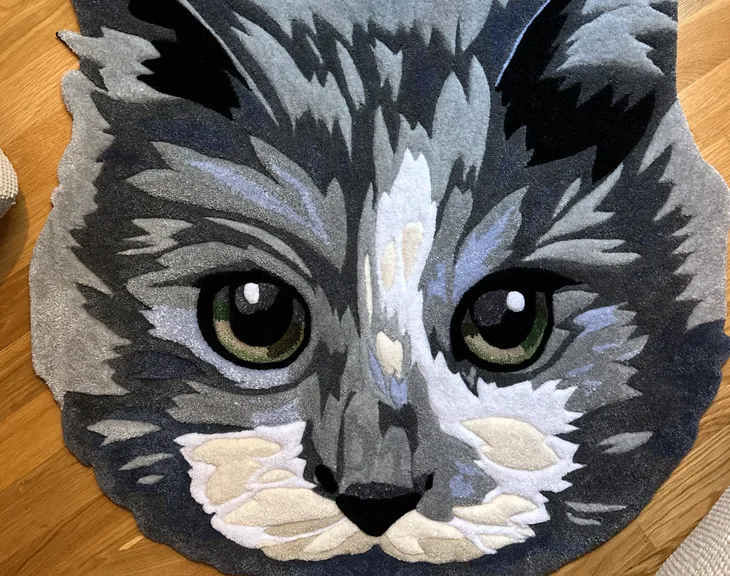
Search for a rug with your dog on it and the results run from twenty euros to several hundred. It looks like the same product at different grades. It is not. Below twenty and above three hundred sit two different objects made by two different processes, and once you know what to look at, telling them apart takes about a minute.
They are not two grades of one thing
A printed pet rug is a knitted or non-woven cloth with your photograph applied to its surface, cut to shape and hemmed. A hand-tufted one is yarn driven through a stretched textile base with a gun, one field of colour at a time, then sheared level and finished by hand.
Neither description is an insult. They are simply different objects, and the rest of this page is the evidence rather than the adjectives.
Turn it over
The fastest test is the side nobody photographs.
A printed mat shows a solid sheet on the back: neoprene rubber, PVC or a foam laminate, sold as a non-slip backing. Nothing of the image reaches it, because the image never went deeper than the surface.
A tufted rug shows a second textile backing glued over the adhesive layer, with binding sewn around the perimeter. Through that layer you can read the stitch rows, because the yarn physically passed through the cloth and came out the other side.
If a listing shows twelve photographs of the front and none of the back, that is information too.
The pile that is not there
Printed pet rugs publish their build openly. A typical one gives about 8 mm of surface nap over a 4 mm cushion, roughly 12 mm in total. The nap is a raised finish on a knit, usually described as faux cashmere or crystal velvet.
Tufted pile is cut yarn standing in the base, commonly up to about 21 mm, and its density is what decides how small a detail can survive. Ours runs about 290 grams of acrylic yarn per square foot. The usual trade figure at this pile height is 227. Tighter stitches hold smaller shapes, which is why an eye reads as an eye rather than as a dark patch.
Density is also why the two objects weigh differently. An 84 x 60 cm tufted piece carries around 1.6 kg of yarn before backing and binding. A printed mat of similar area is a fraction of that, and no photograph can disguise the difference once the parcel is in your hands.
Where the colour lives
Printing puts dye into the top fractions of a millimetre of the fibre. It is called dye-sublimation, and it is genuinely good at reproducing a photograph. What it cannot do is survive abrasion: as the surface wears, the picture goes with it.
In tufting the colour is the yarn itself, through the full height of the pile. Wear the surface and the colour underneath is the same colour. That is the practical reason printed pieces are sold as doormats and kitchen mats, and why we make ours primarily as textile wall art. Placed on the floor they work as decorative rugs, though regular or heavy foot traffic is not recommended.
Black is never worked in black
Here is the difference that decides whether you recognise the animal.
A press reproduces pixels. Where the photograph is dark, the print is dark. A copyist working in yarn does the equivalent, reaching for black yarn wherever the coat is black, and the result is a silhouette with two eyes in it.
A black coat is not black. It is grey where the light lands, blue in the shadow, brown where the undercoat shows. Painters have built volume this way for centuries, and it is the reason a black dog in a tufted portrait looks like a dog rather than a hole. It also cannot be automated, because deciding which grey goes where is judgement, not a filter.
The edge, and what it admits
Printed rugs are cut and overlocked, and their listings often carry a tolerance: final dimensions may vary by an inch or two. That is honest, and it tells you the piece was cut from stock rather than made to a drawing.
A tufted rug is made on a frame to the size on the order, then bound. The dimension in the listing is the dimension you receive.
What happens in the wash
Neither object is laundry, and printed rugs say so themselves: machine washing is not recommended. Nor do we recommend it.
What differs is the failure. On a printed mat the backing delaminates and the image lifts away from the cloth it was printed onto, which is not a repair but an ending. On a tufted rug the adhesive softens and the pile loosens, and that is something a maker can put right.
New tufted pieces shed a little short fibre for the first months. It subsides with ordinary vacuuming and does not touch the structure. It is also the plainest proof of what you are holding: there has to be cut pile before anything can come off it.
Words in a listing that give away a print
None of these are secrets. They are printed on the product pages themselves.
- one-side printing, dye-sublimation, sublimated
- non-woven fabric, crystal velvet, faux cashmere, flannel
- neoprene backing, rubber backing, foam base
- overlock stitching on the edge instead of sewn binding
- ships within 72 hours after approval
- sizes given as exactly 40 x 60 or 50 x 80 cm
- the words doormat, kitchen rug or floor mat inside the description of a portrait
- a tolerance of 1 to 2 inches on the finished size
Any one of them can appear innocently. Three together do not.
The check that takes a minute
Open the seller’s full catalogue, not just the page you landed on.
If a shop offers hundreds of ready-made rugs and your custom portrait costs less than a stock design with a bird on it, personalisation is adding no cost because it is adding no work. It is the same roll and the same press with a different file. That single comparison tells you more than any description.
How much time is inside it
A printed rug ships within 72 hours of you approving the design, and most of that is queueing, not making.
An 84 x 84 cm tufted portrait takes four working days of somebody’s hands: drawing it, matching yarn against the real coat, tufting field by field, waiting for the adhesive, shearing in stages, binding, mounting. Add the mockup you approve before any of it starts, and the honest figure is three to seventeen working days, from the smallest format in the size table to the largest.
That is the whole of the price difference. Not a premium, not a brand: hours and kilograms.
What it is like in the room
This is the part a screen cannot carry, and it is the first thing anyone notices once the parcel is open.
Cut pile has form. The shapes stand off the surface because they are built from yarn at different heights, sheared level and then carved back wherever an edge has to be sharp. Light crosses them and moves as you move, the way it moves across an actual animal. A printed surface is flat and stays flat under any light, because the picture sits on the cloth instead of being made of it.
It is soft in a way a printed nap is not, and warm rather than cool under the hand. Everyone who unwraps one touches it before they say anything.
We cannot prove that on a screen and we are not going to try. It is simply what the object is, and it is the reason the two things in this article were never the same purchase at different prices.
Commission
Have a piece in mind?
Made to order in any size. We reply within 24 hours with a price and a lead time.
Send an enquiry